Every day now, for the past few months, the first thing I do when I wake up isn't checking WhatsApp. I check what my teams of agents have done for me while I slept.
While I was resting, one team crawled hundreds of X posts from dozens of accounts, watched the latest tech and business interviews on YouTube and analyzed their transcripts, while scanning Bloomberg, CNBC, The Information or Harvard Business Review to produce a curated and personalized briefing on the latest AI and technology insights. In parallel, a personal-routines team checked today's weather and alerted me about an Amazon delivery arriving this afternoon, while a third team filtered my corporate emails to check if there's any high-priority email that needs an urgent response.
For the first time, with agents like Hermes, this has become real and truly empowering.
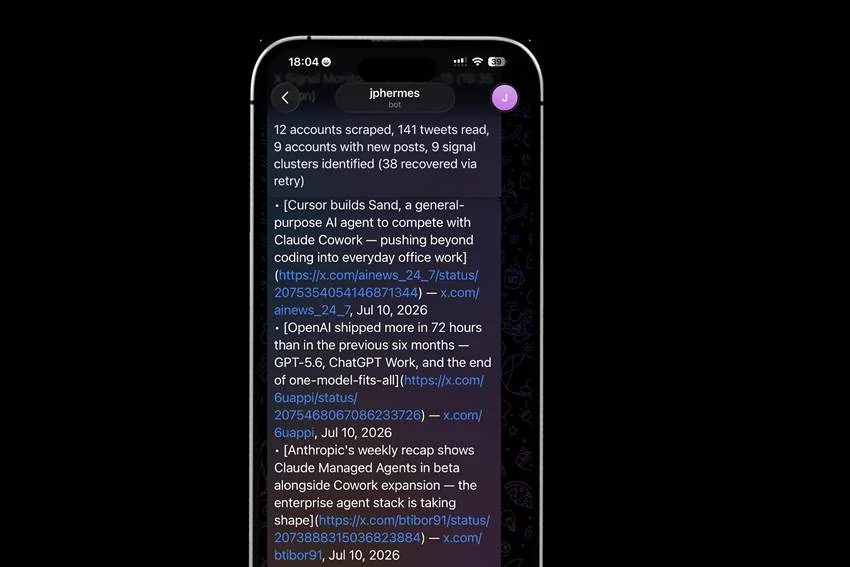
I didn't pay a developer thousands of dollars or wait months for a custom application to do this. I simply talked to a machine, gave it enough tools, and it followed my instructions relentlessly. This is not "one more software". This is a factory that produces real, ultra-personalized work.
Each of these "AI workers" that I "employ" has its own schedule, routines, specifications, goals, and salary (cost of tokens). They arrive at work at different moments of the day (the ones we agreed), and they keep me informed throughout the day. Some workers cost more than others, depending on how challenging their jobs are. Similarities to the corporate world!?
The Age of the "Personalized Software Agency"
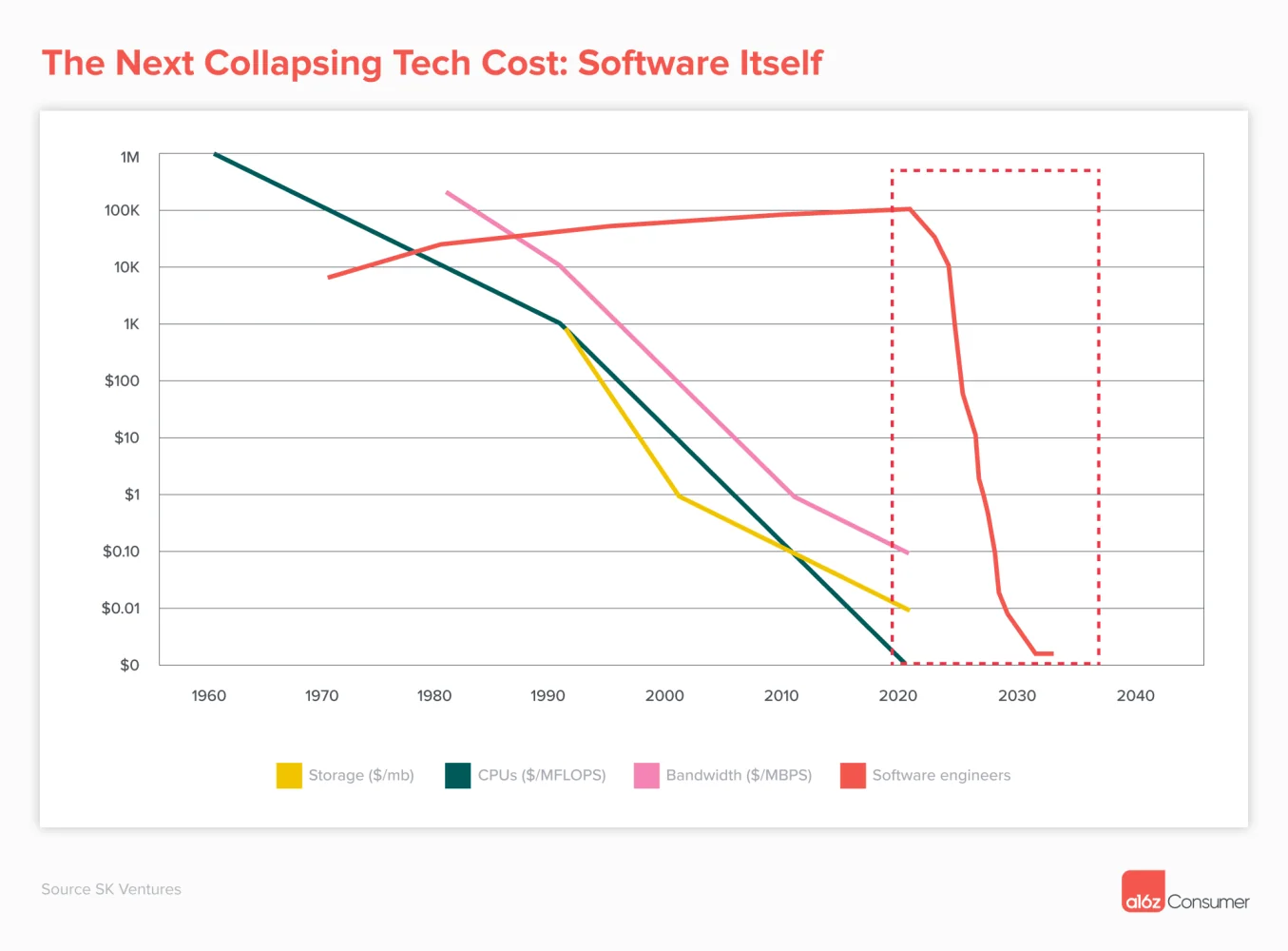
We are entering what a16z's Anish Acharya calls software's "YouTube moment." Just as YouTube democratized video creation, AI is driving the cost of software production toward zero. Software is no longer rigid, expensive, and restricted to an elite of highly paid professionals. It is gradually becoming fluid, something any executive can "specify" using natural language.
In this new world anyone can produce software to solve problems. It's the collapse of traditional software and the birth of ultra-personalized applications that are generated in seconds by your agents, to help you accomplish your goals.
From Producing to Reading - the 0 clicks job
My personal experience dealing with these advanced Agents shows me that the core of our jobs is gradually going to shift from Producing the work to Reading and Verifying the work produced by agents.
In this new reality, your working day might eventually consist of only 20 minutes spent reviewing activity streams and outputs generated by your fleet of agents, both the personal and the corporate ones. You will do 0 clicks in any software.
As a leader, your value no longer comes from your technical expertise or your ability to "do." It comes from your ability to Specify your intent. Strategy, legal work, and financial analysis will all start to morph into "Specifications" - precise instructions that a machine can execute. The person who can take a vague business need and turn it into a "Spec" that Agents can execute flawlessly is the new center of gravity in the organization.
As I tell many of the executives I work with: "you need to lower your Ego and understand that AI is able to do this now". It's time to rethink our job as corporate leaders, and learn how to delegate work to these machines while dedicating more time to architecting and managing their execution. We move from doing to thinking and managing.
How Knowledge Workers must Transform to thrive in the Agentic Economy
OpenAI's latest economic research reveals how work is being transformed by agents, in every department of their company. A few months after "Codex" (an advanced AI Agent) was released to the public, ChatGPT "chat" was still being used as the main default AI tool for work within OpenAI. OpenAI workers were spending less than 10% of their "tokens" on Codex.
However, a few months later, every department suddenly pivoted to use Codex as their primary AI tool for work. What's even more impressive is that this pattern has been growing steeply since April 2026, with roles such as Finance, Legal, or HR taking the lead. These roles at OpenAI now generate more than 85% of their output tokens on Codex.
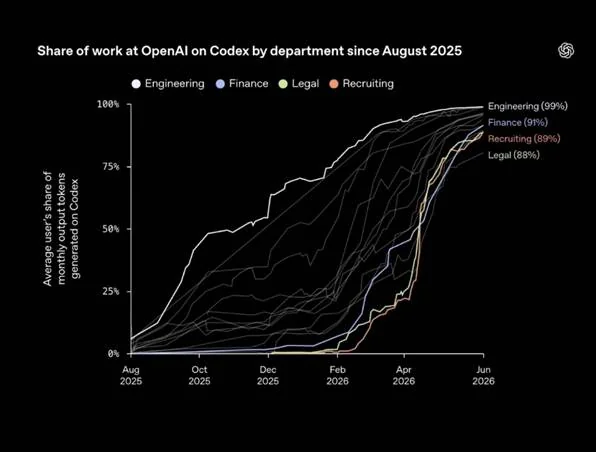
The transformation being witnessed first-hand at OpenAI reflects a broader pattern that helps predict The Next Era of Knowledge Work. The fact that Knowledge workers now represent about 20% of Codex users and are adopting it more than 3x faster than developers at OpenAI, is an early sign of that trend unfolding for traditional organizations.
In the new org chart leaders will need to become builders (by Marc Andreessen) as AI collapses expertise cost and merges traditional roles (coding, design, product management,..) into a single, generalist one: "building with AI". Major tech companies have already started reorganizing their staff into 'builders' and 'builder leads' (the managers). Although at a slower pace, the trend will likely spread to traditional companies and knowledge worker areas. Solving problems with AI Agents becomes the core of any modern corporation.
Beware of the "J-Curve" for AI to become useful
From my experience there is a significant "J-Curve of AI Adoption" where productivity actually dips before it explodes. You need hundreds of hours of "nurturing" and "oversteering" between you and your agents to get them to work flawlessly. You have to put in the hours, like going to the gym, to have the right setup. But when you nail it? It flies.
You go from a traditional operation to a "Lights-Out Operations" mindset where agents produce and review work 24/7, you don't "see it", they're operating in the dark, in parallel, and contact you only when they finish.
At a corporate level, this J-Curve is even harder, as hundreds of factors need to be taken into account to avoid a 95% failure rate pitfall, from the CEO buy-in, to change management, to a modern data and technology architecture. The best CEOs I work with are aware that this is hard work, and that you cannot give up. They ignore the hype, take the lead of these transformations, and invest heavily in the foundations for success: "Do we have a team of powerful ninjas? Is the architecture ready for these agents to constantly access my corporate systems? Is the Data Platform and AI Factory in place? Who's blocking the transformation?…"
The Danger of "Business as Usual"
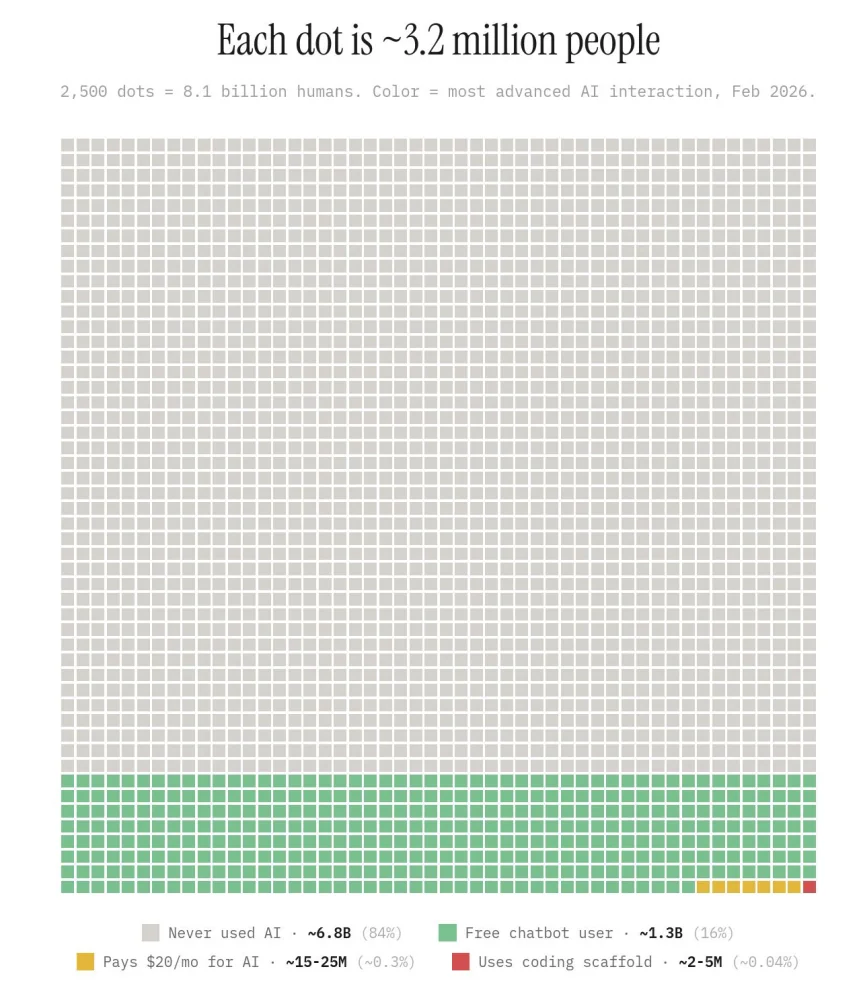
As we enter the deep summer, most will be focusing on vacations and on a return to another "business as usual" environment in September. The gap between public perception and the current reality of these models' capabilities is now enormous. These new models are no longer "chats that hallucinate", they make drastically fewer mistakes, and mostly they can do any digital task humans do in a computer, if well designed and orchestrated by using a set of tools, skills, harnesses and other tricks.
By experiencing the power of advanced AI agents such as Hermes I've felt from personal experience how relentless this new "digital species" can be in accomplishing its goals when you provide it with enough freedom and context, exhibiting the ability to make intelligent decisions as well as humans would do. The trajectory shows us that it will only get better.
The feeling of working with the latest agents
The feeling is that you're always "falling behind" in what is actually possible to accomplish with these incredible "workers", when AI evolves at exponential pace. You have to put in the hours to get this working flawlessly, everyday, like going to the gym. Every time you have spare time, you try to discover what new capabilities you can add to your team of AI employees (agents), in a similar way as you would find new Apps in the App Store.
The mindset shift is understanding that "Agents will find their way through if you give them enough arms and legs" (the tools they can connect to). But after you go through this painful architecture work, when you first see the result of this work, it will shock you how unbelievable these "creatures" are. You will suddenly come to the conclusion that this assistant starts saving you weeks or months of work in a consistent manner, by constantly taking care of all your daily administrative tasks in a single shot. Is that powerful.
Managing your agentic employees from anywhere
One of the most impressive features of these latest agentic tools is also the ability to control your agents remotely, directly from your mobile phone, anytime and anywhere. I frequently instruct my agents, which run on my local computer for privacy reasons, while having a business lunch, travelling, flying, or sitting on the couch late at night watching TV. Work becomes truly boundaryless. It's no longer constrained by time, location, or physical boundaries. It can happen while you jog or sleep.
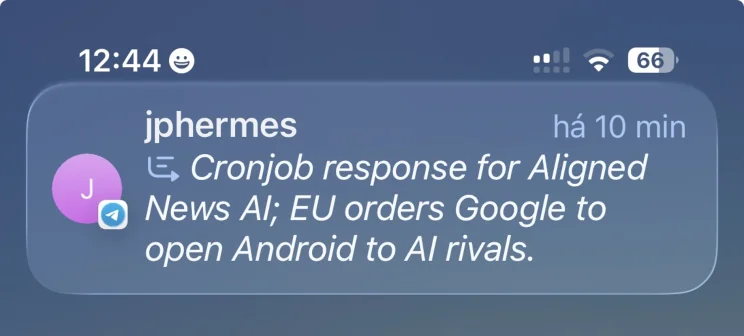
When a task is complete, a notification pops up on my phone from Telegram, just like any other WhatsApp message. Through this channel, we talk and adjust back and forth on any updates needed before the next task.
Final thoughts
The impact on companies and individuals who operate fully on top of advanced Agentic AI systems will be unprecedented. Historically, companies' productivity has been constrained by human bandwidth. Humans think and execute serially, one task at a time, we need to eat, sleep and are constantly being distracted or interrupted. These premises no longer hold in the agentic world. That ceiling is being removed.
We can now operate through parallelization, where each leader in the AI Age will be managing fleets of hundreds of agents and therefore maximizing his/her leverage. Those who don't adapt, become obsolete. Start your learning and experimentation journey, AI won't wait.