Executive Briefing
Business Value vs. Technical Maintenance
Data, AI, and digital transformation are not the same as traditional IT. IT is about maintaining systems, running security, and keeping infrastructure stable. It's about cyber resilience and ensuring operations stay online.
Data and AI transformation, on the other hand, is about creating new business value - it's fundamentally different work that requires a different approach and different leadership.
Building the "Digital Twin" Sideways
The most effective strategy is to build a digital representation - a "digital twin" - of your business sideways. Rather than trying to integrate dozens of legacy systems over a decade, you create a horizontal abstraction layer that captures and unifies information from across the organization.
This allows you to present one face to customers and employees while your underlying systems remain as they are.
The Reality of Heavy Lifting
This is hard work that requires significant heavy lifting. There are no shortcuts - you cannot simply buy this capability from a consultancy or vendor.
The CEO and executive team must be personally committed, blocking their agendas weekly to drive progress. Organizations that treat this as a delegated IT project will fail.
Connecting to the AI Ecosystem
Once you have established this foundation, you gain the ability to move faster. With your data unified in a semantic layer, you can connect to the global AI ecosystem in a flash of a second.
New models, new capabilities, new tools - they all become accessible because you have done the hard work of organizing your information. This is what transforms data from a liability into your most powerful strategic asset.
Executive Briefing
The Death of Explicit Programming
We are exiting the era of computers as mere tools that require us to tell them exactly what to do. The transformer architecture and deep learning have birthed "world models" that understand context natively. The move from 300,000 lines of manual "if-then-else" code to end-to-end neural networks, as seen in Tesla's self-driving evolution, is the only blueprint that matters. Every company must pivot to this approach or face immediate obsolescence.
The Digital Divide and 10x Speed
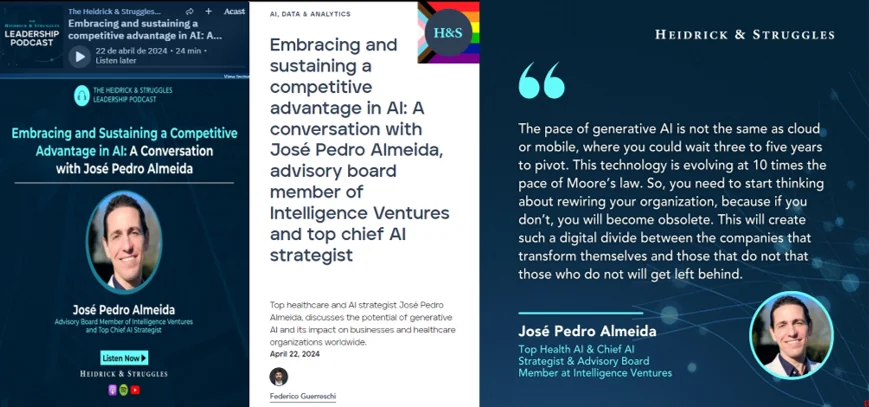
AI is not a slow pivot like mobile or cloud; it is evolving at 10 times the pace of Moore's law. This speed creates a brutal digital divide. If you wait for a five-year plan, you are already dead. Executive teams must operate on two tracks: Everyday AI for immediate "copilot" wins in summarizing emails and meetings, and Game-Changing AI that fundamentally redefines how humans and machines interact.
Decoupling AI from the Legacy IT Trap
The biggest mistake is letting traditional IT handle AI. IT is bogged down by cybersecurity and resilience; they don't have the bandwidth for transformation. You must decouple the data/AI transformation from the IT transformation. Build a separate data platform sideways that captures every phone call, email, and document to create a horizontal intelligence layer. This allows you to extract insights across text, image, sound, and video in a "flash of a second".
The Chief AI Officer and CEO Commitment
Transformations fail because they are "plug-and-play" vendor solutions. You need a Chief AI Officer on the Executive Committee to rewire every business process end-to-end. This requires more than a pronouncement; the CEO must block agendas and personally unlock blockages every week to fight the organization's "immune system".
Executive Briefing
The All-In CEO Mindset
There are no shortcuts to digital excellence. You cannot buy this from a consultancy; the CEO must be "all in" and retrain themselves as an AI CEO. If the top management isn't leading the charge every week, the organization's immune system will kill the project.
Building the "Digital Twin" Sideways
To bypass the technical debt of 80 or 90 fragmented companies, you must build a digital representation or "digital twin" of your business sideways. This horizontal abstraction layer allows you to sound like a single company to your customers while providing the "semantic layer" and context AI needs to bring real value.
Measuring Success via Usage and Natural Outcomes
ROI spreadsheets for AI are often a lie. Success should be measured by usage - how often the intelligence is actually accessed to move faster. Outcomes like massive efficiency gains happen naturally once information moves in a "flash of a second".
Flops per Knowledge Worker
Intelligence now comes as a "log of compute". We are entering an era of a hybrid workforce where you scale through "compute" rather than just headcount. This is the path to the "single-person billion-dollar business," where one human conducts a digital symphony of a thousand non-human agents.