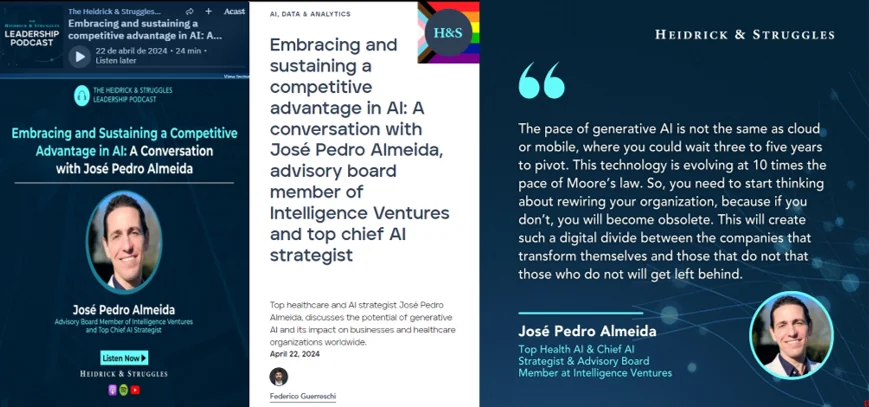
"There are no shortcuts to digital excellence. Most transformations fail because companies try to move too far ahead into the AI world while missing the foundations and sequence of steps needed beforehand."
The Distance Between Hype and Execution
Most AI transformations fail because there is a vast distance between hype and execution, leading to an 80-90% failure rate. Companies often fall into the "plug-and-play" trap, buying isolated vendor solutions instead of building organizational foundations.
To succeed, the leader in charge must be "all-in," which means the entire executive committee must block their agendas and allocate resources every week for years.
"Only 6% of companies are true AI performers. What distinguishes them is that they are guided by vision, not just immediate return on investment."
Empowering the Transformation
A critical secret of successful performers is the appointment of a Chief AI Officer to the Executive Committee to rewire every business process end-to-end. Furthermore, organizations must build an "internal soul" by hiring ninja teams that co-build products side-by-side with business units to ensure trust and adoption.
The CEO must personally empower the transformation to overcome the organization's "immune system," which naturally resists change.
Expecting immediate savings or treating AI as a series of "pilots" is why 87% of AI transformations fail. Leaders must instead invest boldly with a long-term vision - taking risks, driving real usage, and galvanizing the organization around business transformation and innovation, rather than becoming ROI-obsessed.
Listen & Watch the Full Insights
Executive Briefing
Business Value vs. Technical Maintenance
Data, AI, and digital transformation are not the same as traditional IT. While IT manages the systems, digital transformation is about the core business operations and ensuring the entire organization is running as a modern entity. These two teams need to collaborate, but they must each focus on their own specific "turf" to be effective.
Building the "Digital Twin" Sideways
The most effective strategy is to build a digital representation - a "digital twin" - of your business sideways. This is an abstraction layer that sits on top of your existing mess. For your end customers and your employees, it makes the company sound and act like a single, unified organization. Internally, you may still be completely fragmented across your legacy IT, but to the outside world, you operate as one.
The Reality of Heavy Lifting
This is hard work that requires significant heavy lifting; it does not happen overnight. Companies that think they can achieve this level of digital maturity in three to six months are mistaken - it takes years of dedicated effort.
Connecting to the AI Ecosystem
Once you have established this foundation, you gain the ability to move faster and experiment with MVPs. Most importantly, you can leverage all the major AI ecosystems, such as OpenAI and Gemini. Because you are connecting to an abstraction layer rather than trying to integrate with a hundred different legacy IT systems, you bypass a process that would otherwise take ten years to complete.
Executive Briefing
Lost in the "Foam of the Days"
Most boards are "lost in the foam of the days" - distracted by chatbots while ignoring the tectonic shift beneath. While legacy sectors claim to have done AI for 15 years, they are stuck in a narrow, outdated paradigm. The new paradigm is the native ability to comprehend the world immediately - intent, documents, and multimodes.
The Agentic Loop and the End of Cognitive Labor Costs
We are now in the era of Reasoning and Computer Use. Models like Anthropic's can now navigate a computer, use tools, and produce programs in an agentic loop, refining their own work continuously. This drops the cost of cognitive labor toward zero. The ritmo of this acceleration is a tsunami.
Vision-Driven Leadership vs. The ROI Trap
Only 6% of companies are true AI performers. They are guided by vision, not immediate ROI. They don't hire dozens of companies to fix 20 parts of a legacy workflow; they prepare for the agent that will replace the entire workflow. The workforce must shift from "executing" to "supervising" the machine.
The Death of Friction: My Personal Agent
The future is not an app; it's your personal agent that wakes you up after scanning 300 competitors to tell you it found a better rate and already filled out the forms. This is the end of "brutal friction" in the customer interface. Success belongs to companies that master the triad of Data, AI, and Connectivity.
Executive Briefing
The Death of Explicit Programming
We are exiting the era of computers as mere tools that require us to tell them exactly what to do. The transformer architecture and deep learning have birthed "world models" that understand context natively. The move from 300,000 lines of manual "if-then-else" code to end-to-end neural networks, as seen in Tesla's self-driving evolution, is the only blueprint that matters. Every company must pivot to this approach or face immediate obsolescence.
The Digital Divide and 10x Speed
AI is not a slow pivot like mobile or cloud; it is evolving at 10 times the pace of Moore's law. This speed creates a brutal digital divide. If you wait for a five-year plan, you are already dead. Executive teams must operate on two tracks: Everyday AI for immediate "copilot" wins in summarizing emails and meetings, and Game-Changing AI that fundamentally redefines how humans and machines interact.
Decoupling AI from the Legacy IT Trap
The biggest mistake is letting traditional IT handle AI. IT is bogged down by cybersecurity and resilience; they don't have the bandwidth for transformation. You must decouple the data/AI transformation from the IT transformation. Build a separate data platform sideways that captures every phone call, email, and document to create a horizontal intelligence layer. This allows you to extract insights across text, image, sound, and video in a "flash of a second".
The Chief AI Officer and CEO Commitment
Transformations fail because they are "plug-and-play" vendor solutions. You need a Chief AI Officer on the Executive Committee to rewire every business process end-to-end. This requires more than a pronouncement; the CEO must block agendas and personally unlock blockages every week to fight the organization's "immune system".